
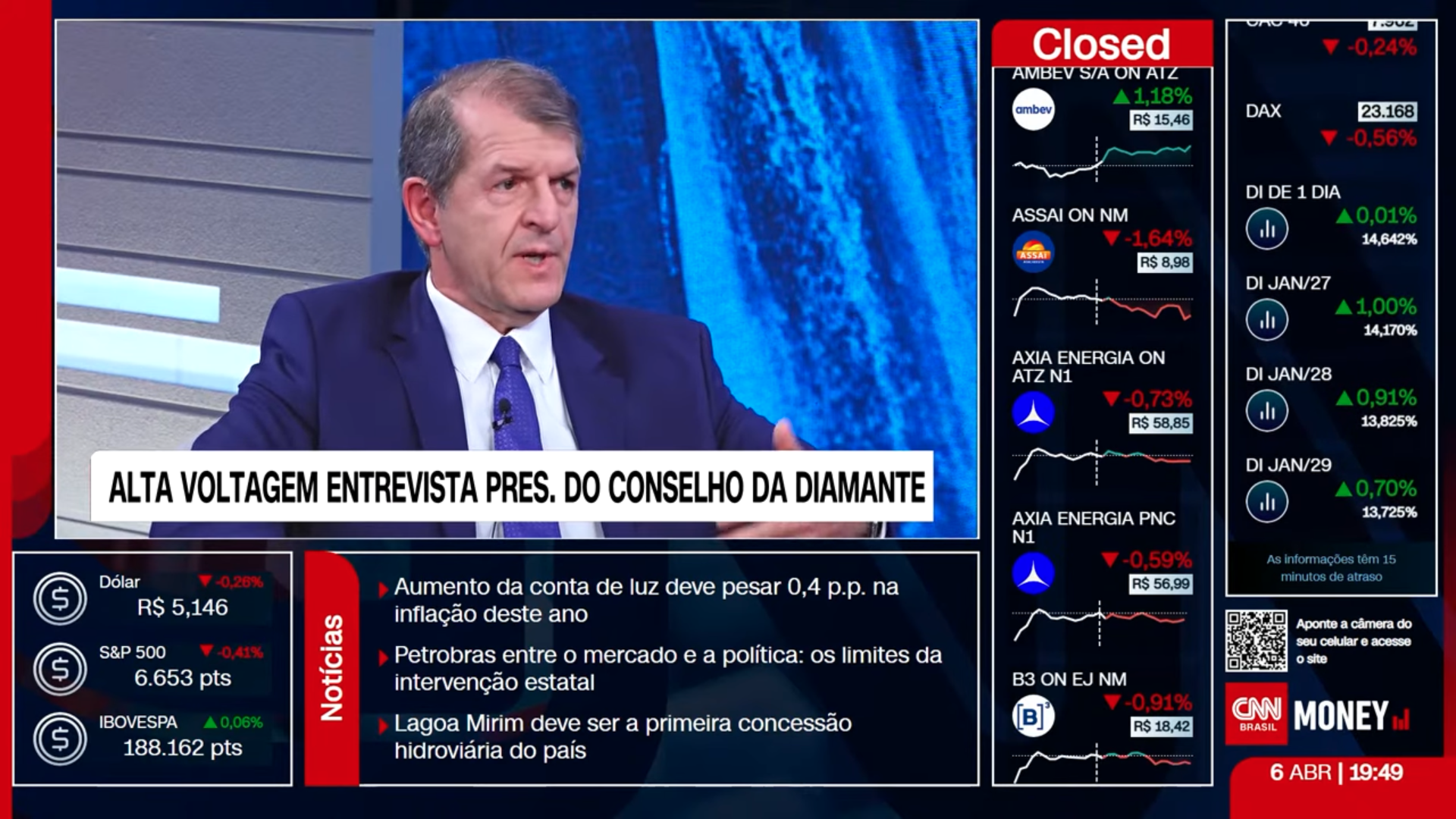
The Diamond Group advances the business diversification strategy focusing on the nuclear sector and the exploitation of critical minerals in line with the growing global demand for inputs linked to the energy transition, the president of the group’s board of directors, Jorge Nemr, said in an interview with CNN Infra’s High Voltage program.
Nemr explained that the company prepares to act on three fronts: exploitation of critical minerals, development of microreactors and food irradiation.
The mining area is under the umbrella of NBEPar –Núcleo Brasil Energia Participações, the group’s nuclear holding company, which recently partnered with Uranium One Group JSC, a subsidiary of the Russian state-owned Rosatom, for the creation of the Nadina Minerals joint venture. The company will focus on the development of strategic mineral exploration projects in the country.
“We are ready to explore critical minerals. We already have requests made in the ANM (National Mining Agency) of various areas in Bahia and Paraná and we are starting the research. Today the focus is on critical minerals, but if we find uranium and the law allows it, that will be a big goal.”
The second axis, according to the executive, is in the technological field. Diamante already participates, in partnership with Finep and a consortium of Brazilian scientific institutions, in the development of the Brazilian nuclear microreactor. With a capacity of 5 MW, the equipment is focused on the supply of energy in isolated systems and is part of a national technological domain strategy in the sector.
The viability of new nuclear enterprises, with the support of private initiative, involves the constitutional and legal framework, since this type of project is a monopoly of the Union.
The third front involves food irradiation, a technology used in about 60 countries to increase durability and food safety. “Brazil is considered the world’s barn in food production. With this technology, we will be able to export food to the world with more lifespan, Nemr said.